Asset recovery

Equipment Repossession in Cleveland and Northeast Ohio

Construction, agricultural, landscaping, and business equipment assignments depend on serial-number verification, operating condition, attachments, site access, and specialized transport needs.

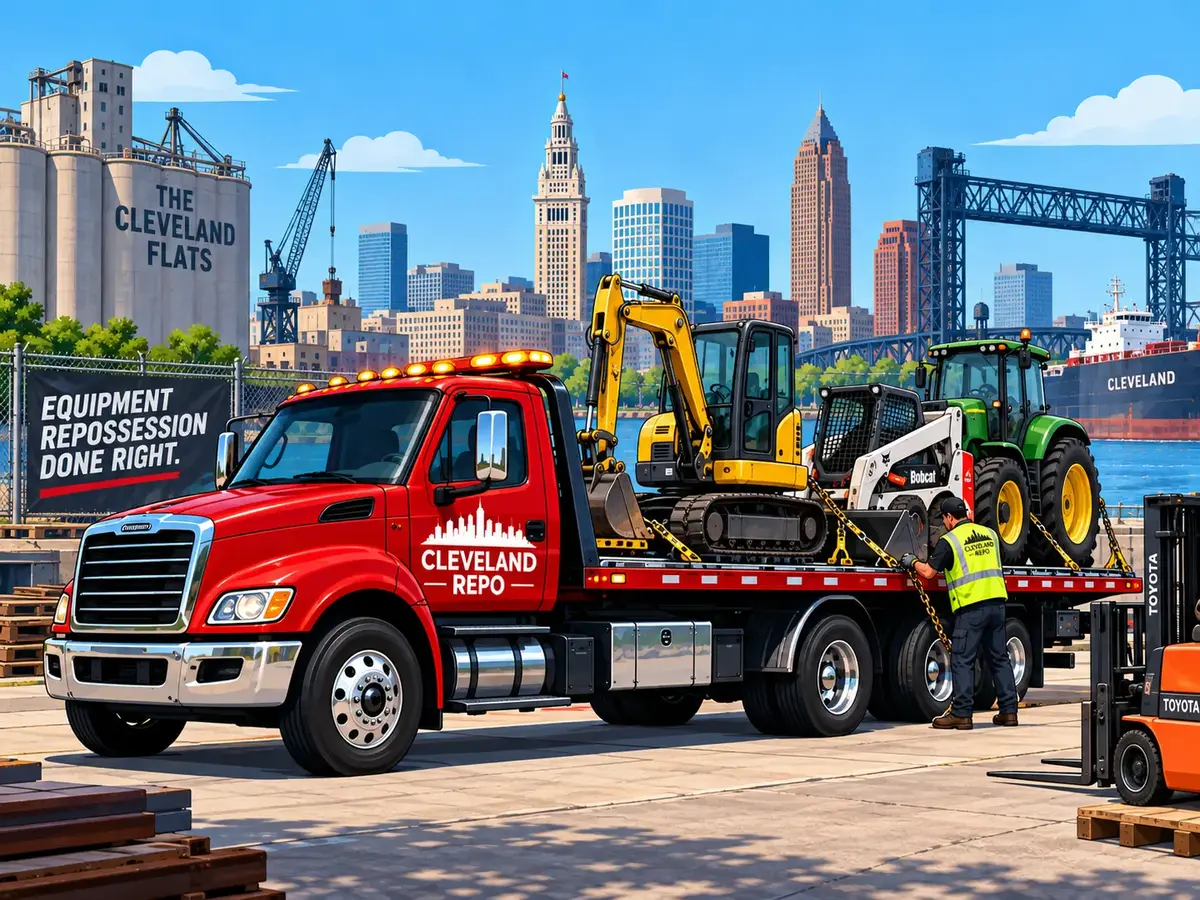
Rollback tow truck transporting recovered construction equipment in Cleveland

Assignment planning

Equipment recovery starts with a precise asset description

Skid steers, compact excavators, loaders, tractors, mowers, lifts, and other equipment may look similar across model years while differing in weight, width, controls, attachments, and transport requirements. The manufacturer's serial number, model, hours, configuration, and available photos are often more useful than a general description.

Equipment may be located at an active jobsite, farm, contractor yard, rental facility, warehouse, repair shop, or remote property. Gates, terrain, overhead clearance, ground conditions, operating schedules, nearby workers, and the asset's mechanical condition can all affect the assignment.
Assignment questions

What lenders often need to clarify

Why is the serial number more useful than a model decal?

Model decals can be damaged, replaced, or shared across similar machines. The manufacturer's serial plate connects the physical equipment to the lender's file and should be verified whenever it can be accessed.

What information helps with non-running equipment?

Report known battery, hydraulic, drivetrain, tire, track, steering, brake, and control problems. Equipment dimensions, weight, attachment position, terrain, and loading access also help define what may be required for movement.

Asset-specific factors

What affects the recovery plan

Serial-number verification

Model decals can be changed or damaged, so the manufacturer's serial plate and lender records are central to identification.

Attachments and implements

Buckets, forks, blades, mowers, trailers, and implements may have separate ownership or may be listed individually as collateral.

Site and transport planning

Weight, dimensions, terrain, clearance, mechanical condition, and loading access help define appropriate movement requirements.

Process

How the assignment moves forward

Define every asset

Confirm the manufacturer, model, serial number, dimensions, attachments, and lender instructions.

Review site conditions

Gather gate, terrain, work-hour, clearance, loading-area, and contact information for the current location.

Evaluate operating condition

Use available information about keys, batteries, hydraulics, tires or tracks, fuel, and known defects to plan the next step.

Document equipment and attachments

Record available photos, serial numbers, hours, condition, implements, location details, and transport status.